Syon Park: The Fortress that Hides a Palace
Syon House - Michael Adair
Syon Park: Robert Adam’s greatest magic trick.
I am going to give you a piece of advice that might seem counterintuitive. When you arrive at Syon House, located just across the river from Kew Gardens in the slightly less glamorous neighbourhood of Brentford, do not look at the building and get back in the taxi.
I say this because, to be brutally honest, the exterior of Syon House is ugly.
It is a stark, castellated block of stone that looks less like a ducal palace and more like a very high end prison or perhaps a barracks for particularly posh soldiers. There is no grand Baroque facade, no welcoming portico, and very little to suggest that you are standing in front of one of the most significant artistic achievements in European history.
But this is exactly the point.
The house belongs to the Duke of Northumberland (the Percy family), who commissioned the Scottish architect Robert Adam in the 1760s to remodel their Tudor mansion. Adam, who never missed an opportunity for theatricality, decided to use the plain, fortress like exterior as a foil. He wanted to bore you on the outside so that when you stepped through the front door, your jaw would hit the floor.
It works.
Syon House - Michael Adair
The Great Hall: A Study in Monochrome
When the doors open, you don’t step into a hallway; you step into Ancient Rome.
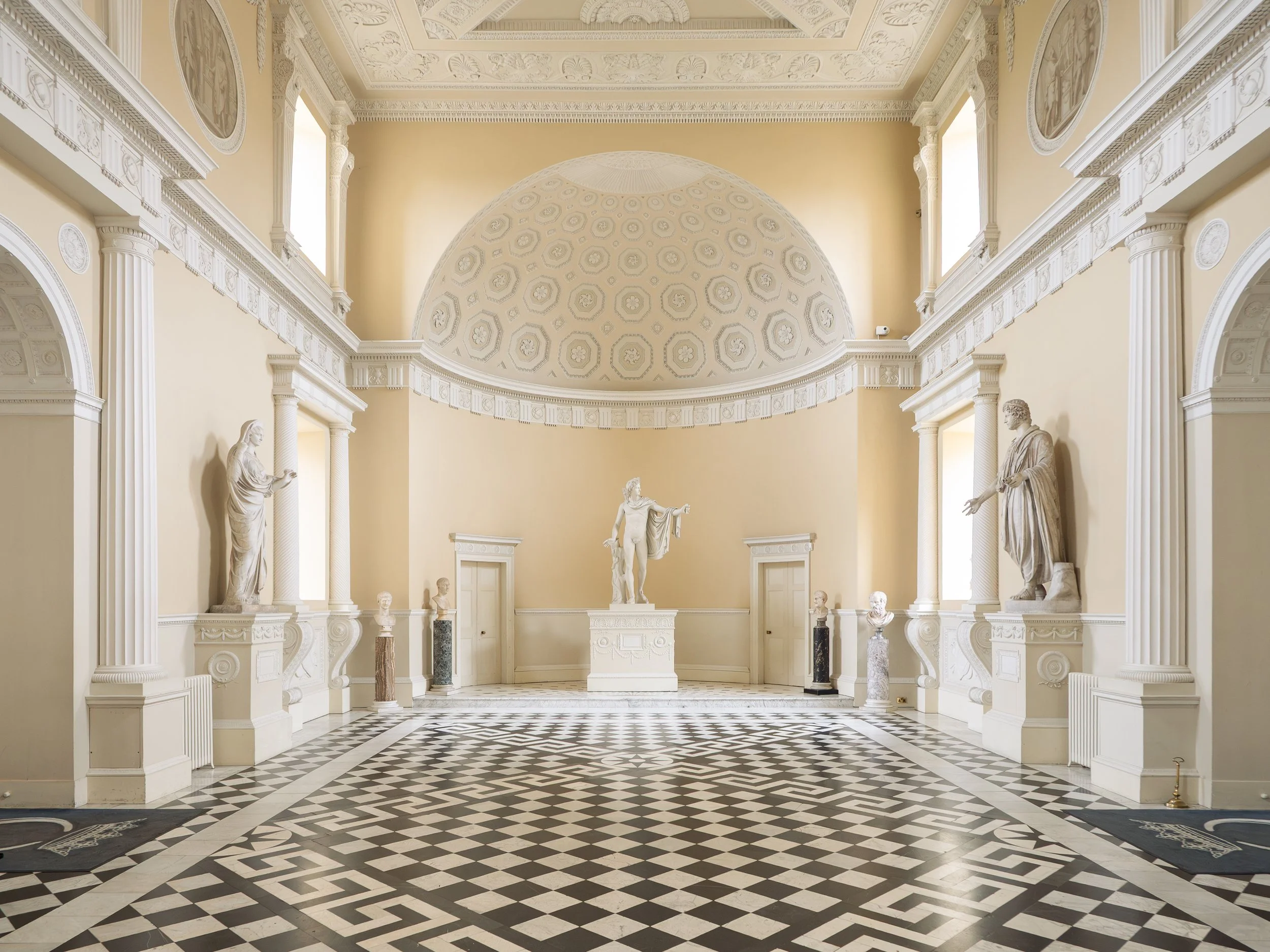
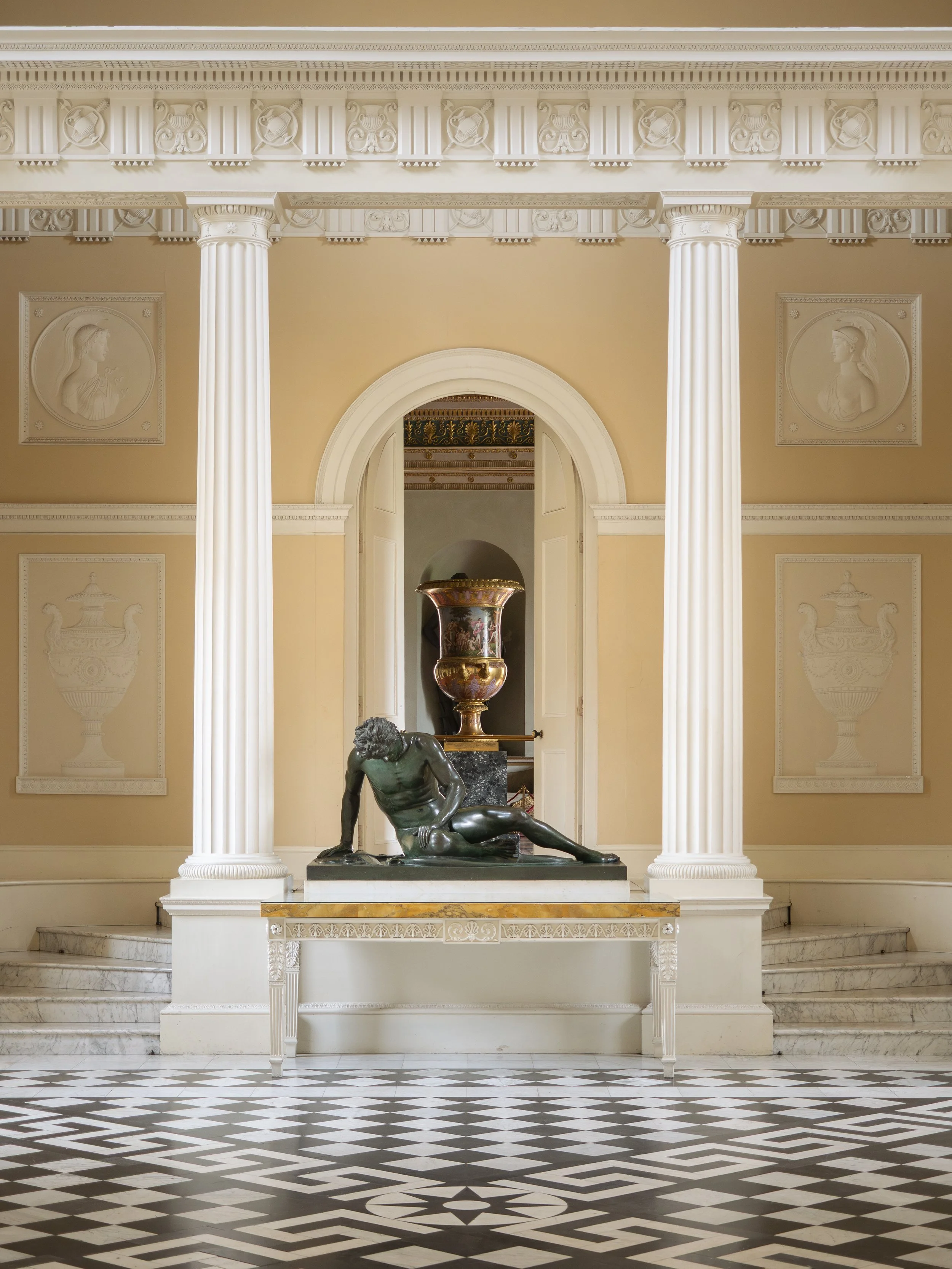
The Great Hall is a masterclass in minimalism, but the expensive kind. Adam stripped away all colour, leaving a space of pure white and grey. It is a double cube room (a perfect geometric shape beloved by classical architects) with a floor laid in black and white marble that mirrors the pattern of the ceiling beams above.
The level of detail here is obsessive. The decorative stucco work is crisp and severe. There is a massive apse at one end inspired by the Pantheon in Rome, containing a statue of Apollo. Adam intended this room to be a "palate cleanser." It is cool, echoing, and intimidating. It was designed to make visitors whisper and perhaps regret wearing muddy boots. It is the architectural equivalent of a deep breath before the plunge.
The Ante Room: The Explosion
If the Great Hall is the deep breath, the Ante Room is the scream.
You turn left from the monochrome Hall and walk into a riot of colour, gold, and movement. This is widely considered to be Robert Adam’s greatest single room, and it is easy to see why.
The space is dominated by twelve massive columns of green verde antico marble. But here is the secret: they aren't marble. They are scagliola, a mixture of plaster, glue, and marble dust, hand polished until it shines like glass. In the 1760s, these cost more to produce than the real stone would have, simply because the craftsmanship required was so intense.
Gold statues of Roman trophies line the walls, and gilded statues stand atop the columns, looking down at you. The floor is a vivid swirl of coloured scagliola patterns. The contrast between the silent, white Hall you just left and this glittering, vibrant box is physically disorienting. It was designed to overwhelm the senses, signalling to the guest that they had moved from the "public" waiting area into the private, princely world of the Duke.
Syon House - Michael Adair
The Dining Room and The Silk
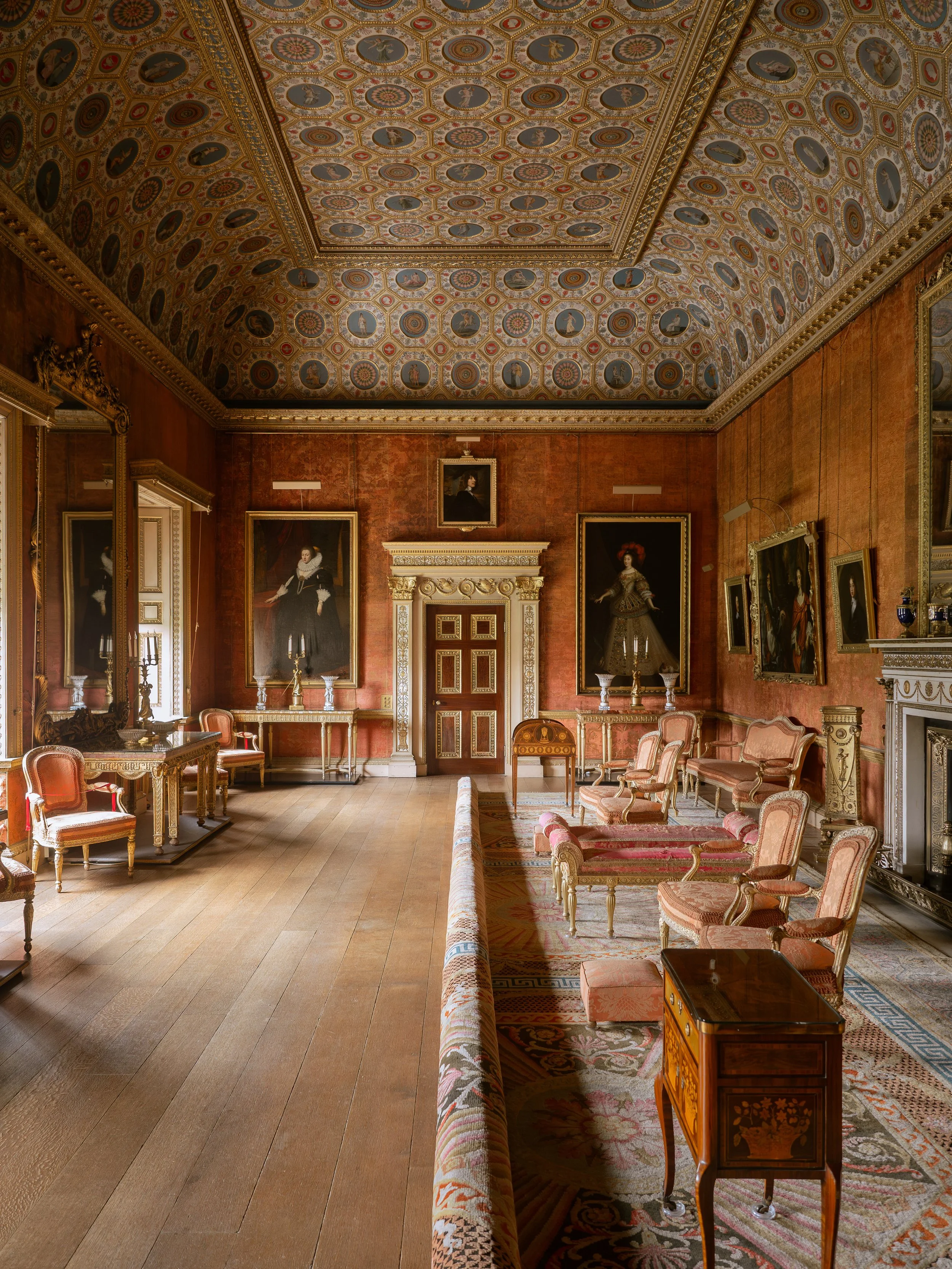
As you move deeper into the house, the mood shifts again. The Red Drawing Room is a space so rich it feels edible. The walls are hung with crimson Spitalfields silk damask.
What is remarkable here is the survival of the fabric. Textiles are usually the first thing to rot in a historic house, but these walls still shimmer with that deep, metallic red that you usually only see in oil paintings. The ceiling is covered in 239 roundels painted by the artist Angelica Kauffman, who was one of the two female founding members of the Royal Academy.
It is worth pausing to look at the carpet. It was hand knotted in 1769 by Thomas Moore of Moorfields specifically for this room. If you look up at the ceiling and then down at the floor, you will see that the pattern of the carpet mirrors the plasterwork above. Robert Adam was a control freak in the best possible way; he designed everything down to the door handles and the carpet weave to ensure total harmony.
This room served as the evening retreat for the ladies, and Adam ensured the setting was dramatic enough to match the gossip. The doorcases are lined with pilasters covered in intricate gold leaf, designed to catch the flicker of candlelight and turn the entire space into a shimmering, crimson jewel box.
Syon House - Michael Adair
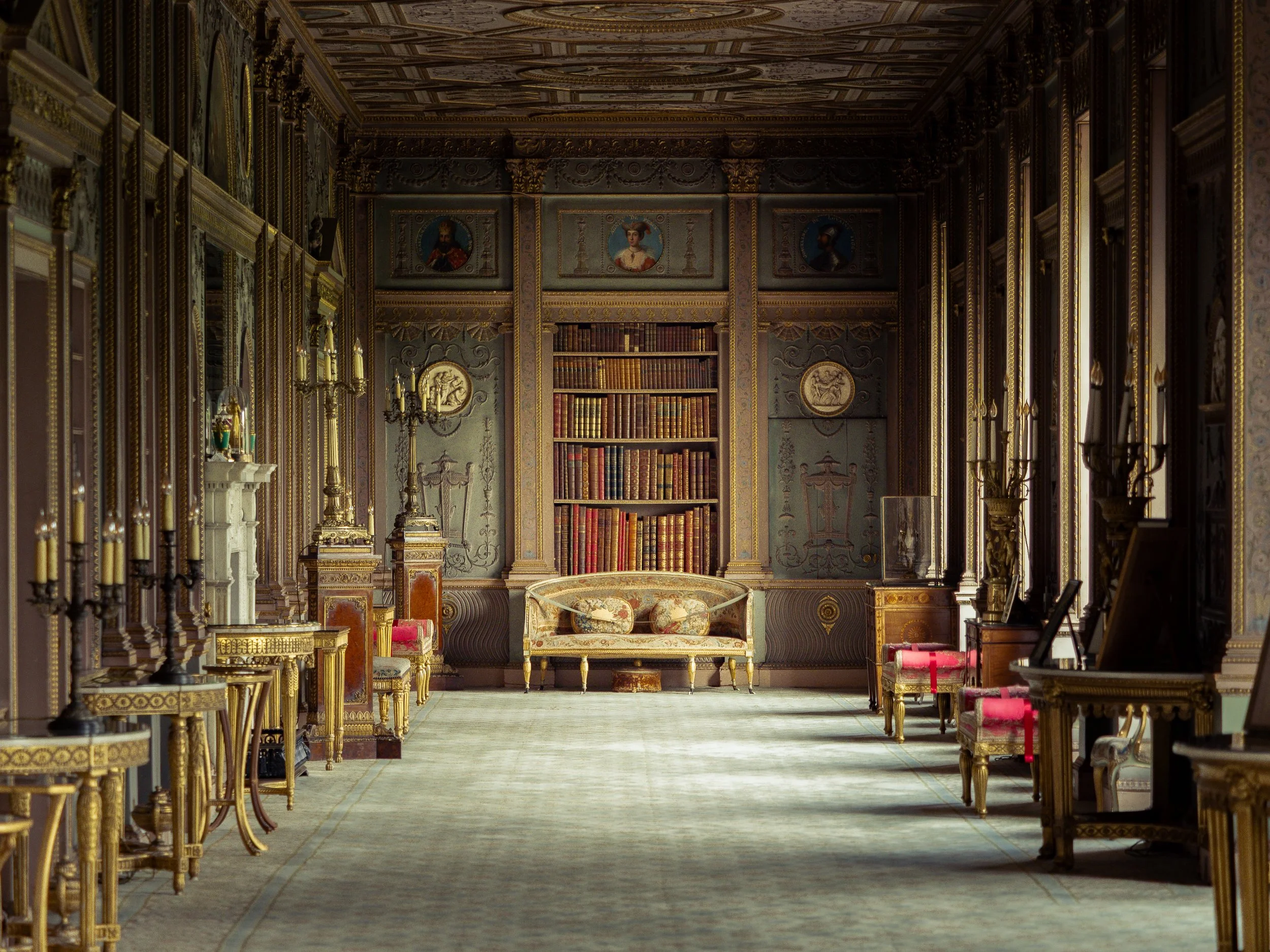
The Long Gallery: A Tudor Ghost
The final showstopper of the main circuit is the Long Gallery.
This room is actually a survival from the original Tudor house. In the 16th century, wealthy people liked to have a long, thin corridor for indoor exercise during bad weather. When Adam arrived, he was stuck with this weirdly narrow dimension (136 feet long but only 14 feet wide).
Instead of fighting it, he leaned into it. He used optical illusions to widen the space, breaking up the long walls with pilasters and bookshelves. It was designed as a "ladies' withdrawing room," a place for conversation and needlework, so the decoration is lighter and more playful than the masculine Roman halls at the entrance.
It feels like the most civilized library in the world, stretching out into infinity.
The Great Conservatory
Finally, you must walk out into the gardens to see the Great Conservatory.
Built in the 1820s by Fowler, this glass and metal dome predates the famous Crystal Palace. It is a delicate, filigree cage of glass that looks like a giant piece of jewellery dropped onto the lawn. It was the filming location for a few key scenes in Bridgerton, but don’t let that put you off. It is a marvel of early industrial engineering, blending the strength of iron with the elegance of a classical temple.
Syon House - Michael Adair
The Practical Details
Opening Times: Syon House is still a private home (the Duke actually lives here), so it is only open on Wednesdays, Thursdays, and Sundays between March and October. Do not just show up on a Tuesday; the gates will be locked.
Location: It is in the flight path of Heathrow, so every few minutes a plane roars overhead. Strangely, this adds to the charm. You are standing in a Roman fantasy while modern engineering screams above you.
The Gardens: Capability Brown designed the landscape, which basically means the lakes and hills look entirely natural but were actually moved by hand by hundreds of men with shovels.
Syon House is a reminder that you should never judge a book, or a Duke’s house, by its cover. The plain grey wrapper hides the most colourful candy in London.